
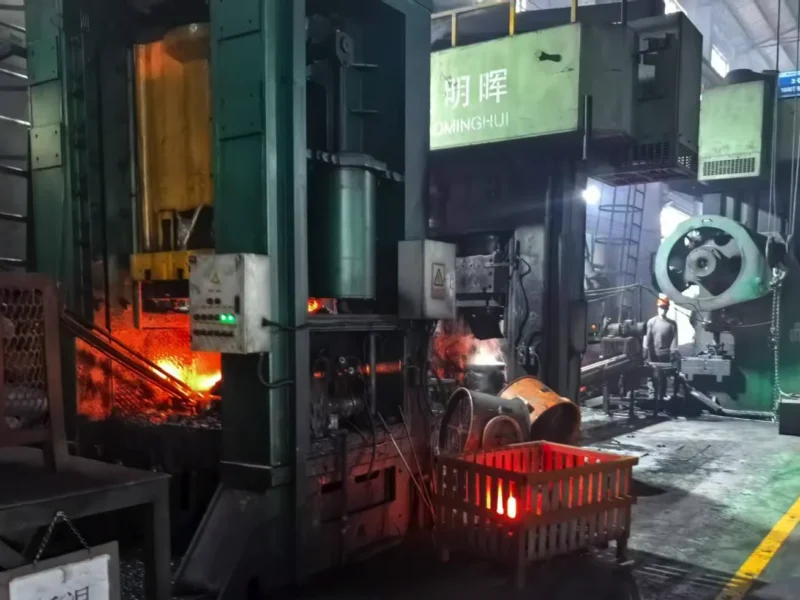

🔥 Gas Furnace Sizing for Hot Forging of Brass Billets
Summary: This article presents the design of a continuous gas furnace for heating brass billets intended for hot forging. Two production scenarios are analysed: high capacity (500g/piece, 720 kg/h) and low capacity (100g/piece, minimum batch of 5,000 pieces). The goal is to provide a flexible sizing that adapts to demand variability.
1. Introduction
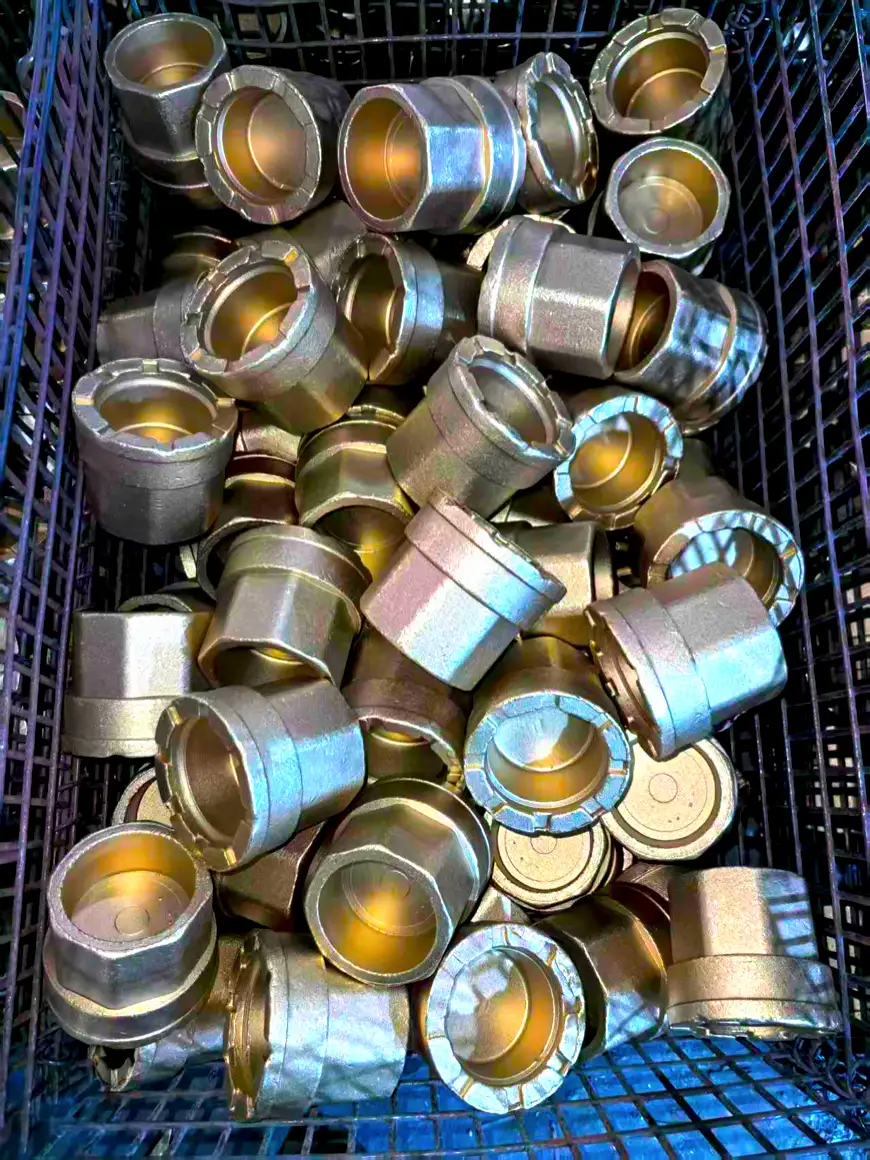
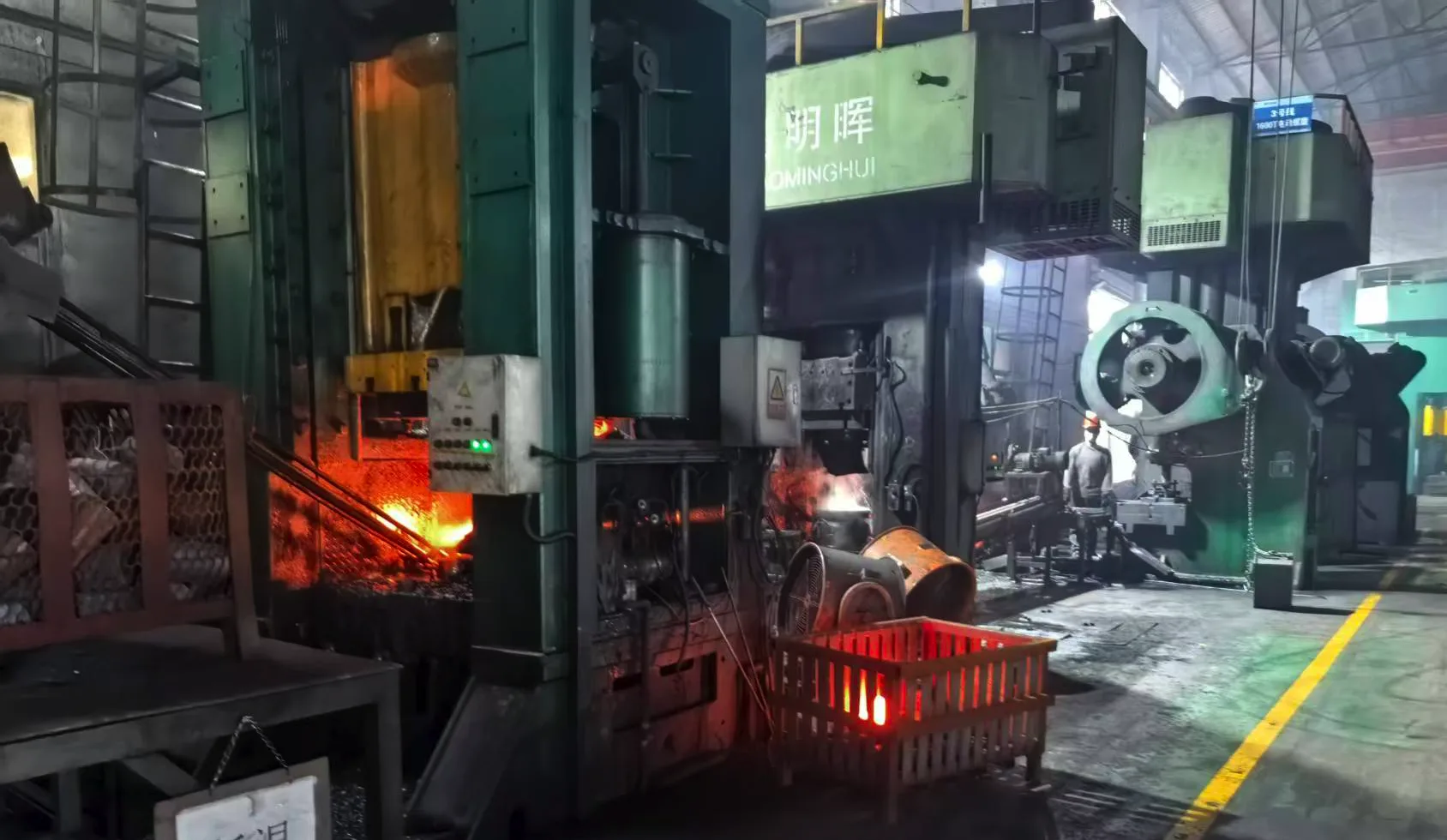
Hot forging of brass requires heating billets to temperatures between 700°C and 750°C before press forging. The choice of a gas furnace — especially in contexts like Serbia where thermal energy costs are significantly lower than electricity — represents a cost-effective solution despite lower efficiency compared to induction heating.
Considered parameters: Material: Brass (copper-zinc alloy) | Target temperature: 700–750°C | Fuel: Natural gas (methane).
2. High-Capacity Scenario (Continuous Production)
2.1 Base data
| Parameter | Value |
|---|---|
| Material | Brass |
| Single billet weight | 500 g |
| Pieces per cycle | 2 |
| Time per cycle | 5 seconds |
| Hourly productivity | 720 kg/h |
| Billet diameter | 40 mm |
| Billet length | ~50 mm |
| Forging temperature | 700–750°C |
2.2 Required thermal power calculation
Specific heat of brass (average 20–700°C): 0.38 kJ/(kg·K)
ΔT = 700°C – 20°C = 680 K
Energy per kg = 0.38 × 680 = 258.4 kJ/kg
Total hourly energy = 720 kg/h × 258.4 = 186,048 kJ/h
Power absorbed by metal = 186,048 / 3600 = 51.7 kW
2.3 Furnace efficiency & burner power
For a continuous gas furnace with small chamber and frequent openings (every 5 seconds), thermal efficiency is in the range of 12–15%. A conservative value of 12% is assumed.
Burner thermal power = 51.7 kW / 0.12 = 431 kW.
Adding a 20% safety margin for additional losses (radiation, convection, openings):
Recommended thermal power: 600–650 kW (≈ 550,000 kcal/h)
Natural gas consumption (Lower heating value: 10 kWh/Nm³): 65–70 Nm³/h of methane.
3. Critical Furnace Dimension: The Soak Zone (Equalization Zone)
The most underestimated parameter is the hot zone length (soak zone). Unlike induction heating which acts in depth within seconds, a gas furnace heats brass by convection and radiation, requiring significant residence time.
3.1 Mandatory length calculation
| Factor | Value | Explanation |
|---|---|---|
| Heating time per billet | 90–120 seconds | Time needed for the core of Ø40 mm billet to reach 700°C |
| Loading rate | 1 billet every 5 seconds | 2 pieces per cycle, staggered entries |
| Permanent billets in queue | 90/5 = 18 billets | Number of pieces always inside the furnace |
| Length occupied by 18 billets | 18 × 50 mm = 900 mm | Without gaps |
| Handling gaps | +50% | For walking beam or pusher systems |
| Minimum hot zone length | 1,350 – 1,500 mm | Mandatory requirement |
3.2 Heating channel dimensions (for Ø40 mm billets)
| Parameter | Value | Reason |
|---|---|---|
| Channel width | 80 mm | Space for two billets side by side (40+40) |
| Channel height | 70 mm | Sufficient for mechanical handling |
| Furnace operating temperature | 750–800°C | To ensure 700–750°C at the core |
4. Low-Capacity Scenario (Minimum Batches)
4.1 Data for low-capacity production
| Parameter | Value |
|---|---|
| Single billet weight | 100 g |
| Billet diameter | 15 mm |
| Billet length | ~60 mm |
| Minimum batch size | 5,000 pieces |
| Typical hourly output | 100–200 kg/h (variable) |
4.2 Impact on furnace sizing
| Parameter | 500g billet (Ø40mm) | 100g billet (Ø15mm) | Difference |
|---|---|---|---|
| Gas heating time | 90–120 s | 30–40 s | Smaller diameter reduces time |
| Billets in queue (same cadence) | 18 pcs | 8–10 pcs | Less accumulation needed |
| Thermal power required (for 200 kg/h) | N/A | ~150–180 kW | Modulable by burner |
4.3 Challenges of minimum batch production
- Cold start: A 650 kW furnace requires 30–60 minutes to reach thermal regime. For a batch of 5,000 pieces of 100g (500 kg total), furnace heat-up time can be comparable to actual production time.
- Idle energy consumption: Even without load, the furnace consumes gas to maintain temperature (typical losses: 30–50% of nominal power).
- Operational flexibility: The furnace must operate at reduced power (burner turndown ratio) typically 5:1 or 10:1.
4.4 Recommendations for variable production
| Strategy | Description |
|---|---|
| Modulating burner | Install burner with turndown ratio ≥10:1 (e.g., 60–650 kW) |
| Superior thermal insulation | Refractory thickness ≥200 mm to reduce idle losses |
| Batch production planning | Accumulate small-piece orders to run in a single shift |
| Two-zone furnace | Separate preheating zone from equalization zone, activatable depending on volume |
5. Summary of Design Parameters
| Parameter | High Capacity (500g) | Low Capacity (100g) |
|---|---|---|
| Hourly productivity | 720 kg/h | 100–200 kg/h (variable) |
| Installed thermal power | 600–650 kW | 150–180 kW (modulable) |
| Full load gas consumption | 65–70 Nm³/h | 15–20 Nm³/h |
| Hot zone length | 1,500–2,000 mm | 800–1,000 mm |
| Channel width | 80 mm | 50 mm |
| Heating time | 90–120 seconds | 30–40 seconds |
| Recommended min batch | 20,000 pcs | 5,000 pcs |
6. Minimum Length Verification with Variable Production
The mandatory length calculation of 1.5–2.0 meters was performed for the worst-case scenario (500g billet, maximum production). In reality:
- When production is reduced (e.g., batches of 5,000 pieces of 100g), the loading rate decreases, thus the number of billets in queue is smaller.
- A 1.5 m long furnace remains valid: you can reduce the advancing speed or introduce gaps between billets without losing productivity.
- A shorter furnace (e.g., 800 mm) would not sustain maximum production with 500g billets.
✔ Maximum production: 720 kg/h (500g, 5 sec cycle)
✔ Minimum efficient production: ~100 kg/h (100g, 30–40 sec cycle)
✔ Minimum batches of 5,000 pieces manageable with adequate scheduling.
7. Operational Conclusions (for Serbia, advantageous gas cost)
- Installed power: 600–650 kW thermal (consumption 65–70 Nm³/h gas).
- Furnace length (hot zone): mandatory minimum 1,500 mm.
- Burner: modulating with turndown ratio ≥10:1.
- Insulation: refractory thickness ≥200 mm on all walls.
- Automation: variable-pitch walking beam system to adapt to different batches.
A furnace with these characteristics will efficiently handle both large continuous productions and small batches, without requiring separate investments for different lines.
Calcolatore Energia + Produttività
Configura peso billette, consumo gas orario, prezzi energia e cambi valuta. I costi si aggiornano in tempo reale per Serbia (USD/RSD) e Italia (EUR). Basato su dimensionamento forno da 65 Nm³/h.
