
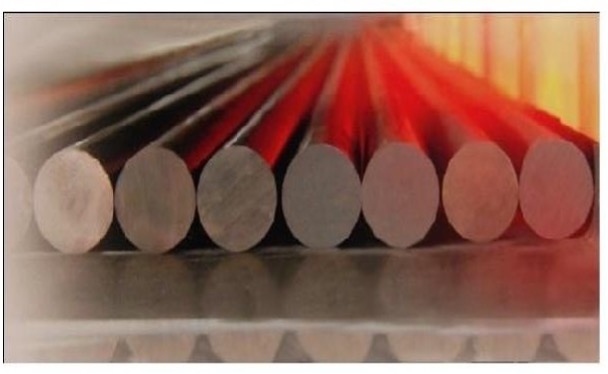
Comparative Analysis of Heating Methods for Brass Billet Forging
Natural Gas Furnace vs MF Induction Furnace · SME Context · Rev. 1.0
Executive Summary
This report evaluates Natural Gas Furnaces and Medium Frequency Induction Furnaces for pre-forging heating of brass billets to their plastic deformation temperature range of 650 – 850 °C. The selection of heating technology is a strategic decision impacting metallurgical quality, die life, energy expenditure, and production flexibility. In the Serbian 2026 context, regulated SME tariffs show a critical differential: natural gas (~5 RSD/kWh) is about 3.3x cheaper than electricity (~16.5 RSD/kWh), heavily impacting TCO despite induction's higher efficiency.
Superior thermal homogeneity (ΔT < 5 °C core-to-surface), ideal for large-diameter billets. Lower energy cost and excellent production buffer via soaking zone.
Heating rates up to 500 °C/min, instantaneous start-up, zero on-site combustion emissions. Suited for high-volume continuous production with tight just-in-time requirements.
Section 01
Introduction & Material Basis
Brass alloys (Cu–Zn systems, typically CW617N / CZ122 / H62) are the dominant material for hot-forged components: valve bodies, fittings, connectors, and structural hardware. Their forgeability is maximised at elevated temperatures where the face-centred-cubic (FCC) α-phase and the body-centred-cubic (BCC) β-phase coexist, reducing yield strength and improving ductility.
The choice of heating technology for brass billets before forging is a strategic decision impacting metallurgical quality, die life, energy consumption, and production flexibility. This report compares natural gas furnaces and medium frequency (MF) induction furnaces in the specific context of small and medium enterprises (SMEs) in Serbia, using data updated to spring 2026.
Data Sources: AERS (Serbian Energy Agency), EPS (Elektroprivreda Srbije), Srbijagas, GlobalPetrolPrices (September 2025, updated 2026), Serbia-Energy.eu (January 2026). Regulated tariffs for small customers with consumption up to 100,000 m³/year of gas.
💡 Key Cost Difference: In Serbia, the electricity price for SMEs is ~16.5 RSD/kWh, while the equivalent natural gas cost is ~5.0 RSD/kWh. This makes gas about 3.3 times cheaper per thermal kWh, thanks to the favorable Gazprom contract extended until 2026. However, this difference can vary significantly based on company location and source availability (e.g., gas grid access or low-cost renewable electricity).
Section 02
Technology Overview
Principle: Controlled combustion of CH₄ + air transfers heat via convection, flame impingement, and radiation from refractory walls.
Design: Multi-zone: heating zone (rapid ΔT) + soaking/holding zone (temperature equalisation across billet cross-section).
Required infrastructure: Gas line, chimney, safety systems, ventilation.
Principle: AC at medium frequency (500 Hz – 10 kHz) through a copper coil induces eddy currents inside the billet; heat generated by Joule effect (I²R) directly in the metal.
Design: Through-feed coil system; billets pushed continuously through the electromagnetic field.
Required infrastructure: High-power electrical supply, water cooling system.
Section 03
Comparative Analysis
3.1 Energy Efficiency
Induction furnaces transfer energy directly into the workpiece with a typical electrical-to-billet efficiency of 90–95%. Gas furnaces lose significant energy through exhaust gases and refractory heat storage; their billet heating efficiency is typically 45–65%, though recuperative burner systems can raise this to ~75%.
3.2 Heating Rate & Thermal Dynamics
The table below summarises characteristic heating rates and thermal response parameters for both technologies. These parameters directly determine production throughput and the feasibility of just-in-time manufacturing schedules.
3.3 Metallurgical Impact on Brass
The heating method has a direct influence on grain structure, surface integrity, and forging response. Three mechanisms are critical:
Selective removal of Zn from the alloy surface. Occurs above ~600 °C in the presence of oxygen. Induction-heated billets exhibit a dezincification depth of 0.1–0.3 mm vs. < 0.05 mm for reducing-atmosphere gas furnaces.
Oxidation layer (CuO, Cu₂O, ZnO). Gas furnace with slightly reducing atmosphere (λ ≈ 0.95): scale loss 0.3–0.7 % of billet weight. Open induction coil: 0.8–1.5 % weight loss (3× higher).
Prolonged soaking at > 800 °C promotes grain coarsening (ASTM grain size < 3). Gas furnaces risk this if soaking times exceed 45 min; induction eliminates this risk but may produce fine uneven grains in the core.
3.4 Operational & Infrastructure Costs
Despite induction's superior efficiency, the Serbian tariff differential reverses the economic equation.
| Parameter | Electricity | Natural Gas | Difference / Advantage |
|---|---|---|---|
| Specific consumption | 0.32 kWh/kg | 0.55 thermal kWh/kg | Gas more dispersive but low price |
| Cost per kg | ≈ 5.28 RSD/kg | ≈ 2.75 RSD/kg | -48% |
| Hourly cost (1,080 kg) | ~5,702 RSD | ~2,970 RSD | Savings ~2,732 RSD/hour |
| Annual cost (3,240 ton) | ~17.1 million RSD | ~8.9 million RSD | Savings 8.2M RSD/year |
🛠 Production Cost Calculator
Adjust parameters to see real-time cost changes. Defaults based on Serbia 2026 scenario (2×600g every 4s, 10h/day).
📋 Production Parameters
⚡ Energy Parameters (EDITABLE)
📊 Calculation Results
* Energy costs update automatically when modifying parameters above. Indicative values, excluding maintenance and depreciation.
3.5 Environmental & Safety Compliance
| On-site CO₂ | ~0.20 kg/kWh input |
| NOₓ emissions (typical) | 80–200 mg/Nm³ |
| Permitting complexity | Medium–High |
| Explosion risk | Present |
| On-site CO₂ | Zero (Scope 1) |
| NOₓ emissions | Zero |
| Permitting complexity | Low |
| Scope 2 CO₂ (grid) | Grid-dependent |
Section 04
Summary Comparison Table
| Parameter | 🔥 Natural Gas Furnace | ⚡ MF Induction Furnace |
|---|---|---|
| Heating Mechanism | Flame, convection, radiation (external) | Joule effect via eddy currents (internal) |
| Start-up Time | 30–60 min (refractory preheat) | < 1 min (instantaneous) |
| Heating Rate | 5–15 °C/min | 100–500 °C/min |
| Core-to-Surface ΔT (50 mm billet) | < 5 °C (after soaking) | 20–60 °C (frequency-dependent) |
| Production Buffer | Excellent — holding zone | Poor — coil must be emptied |
| Surface Oxidation / Scale Loss | 0.3–0.7% (reducing atmosphere) | 0.8–1.5% (open coil) |
| Dezincification Depth | < 0.05 mm | 0.1–0.3 mm |
| Die Life Impact | Positive — uniform material flow | Neutral / Negative — harder surface |
| Electrical Energy Efficiency | 45–65% (≈75% recuperative) | 90–95% |
| Energy Cost per kg (Serbia 2026) | ~2.75 RSD | ~5.28 RSD (+48%) |
| On-site CO₂ / NOₓ | Present | Zero |
| Annual Maintenance (estimated) | 800 – 1,800 € + spare parts | 300 – 800 € + cooling/electronics |
| Large Diameter (> 80 mm) Suitability | Excellent | Requires low-frequency & soak time |
✅ Decision Table · Gas vs Electric for High Production (>3,000 ton/year)
| Factor | Electric | Gas | Ideal for... |
|---|---|---|---|
| Energy cost | High | Very low | Gas |
| Brass precision/quality | Minimal oxidation | Oxidation risk | Electric |
| Initial investment | Higher (induction) | Lower | Gas |
| Maintenance & compliance | Simple | Complex (safety) | Electric |
| Serbia availability | Everywhere | Requires gas grid | Electric if no gas grid |
Section 05
Conclusions & Recommendations
No single technology is universally superior. Selection must be based on a structured cost-benefit analysis incorporating local utility pricing, billet geometry, production cadence, and regulatory environment.
🔥 Select Natural Gas Furnace when:
- Billet diameter exceeds 60–80 mm (skin depth limitations of induction)
- Die life and material flow are primary quality KPIs
- Production line has frequent short stoppages (> 15 min/shift)
- Local gas prices are < 50% of electricity on kWh basis (as in Serbia 2026)
- Reducing atmosphere is required to minimise dezincification (e.g., pressure valve seats, corrosion-critical components)
- Capital budget is constrained (gas furnaces typically 30–50% lower CAPEX)
⚡ Select MF Induction Furnace when:
- High-volume continuous production (> 15 billets/min) is required
- Rapid start-up / shut-down cycles are operationally mandated
- Facility is subject to strict emission regulations (EU IED, local permits)
- Billet diameter is ≤ 50 mm and frequency can be optimised
- Electricity is competitively priced (renewables, long-term contract)
- Clean production environment required (ESD, precision components)
